Meaning of La Mano de Punta del Este (Los Dedos)
La Mano, also known as Los Dedos de Punta del Este, is much more than a beach photo: it is a public artwork with a precise title and intent. In this guide we explain what it means, where it comes from, and why it became the icon of Punta del Este.
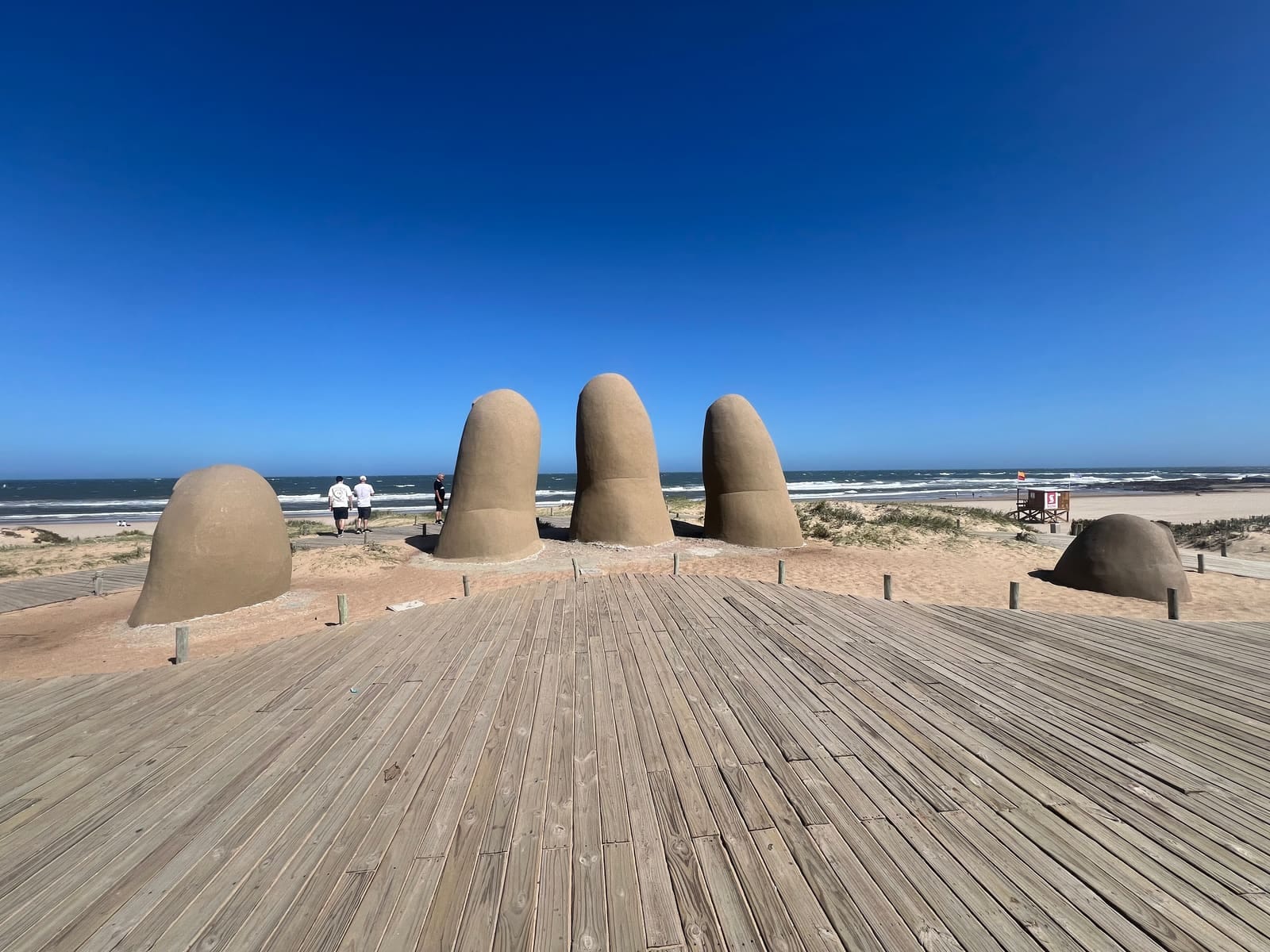


What does La Mano represent?
The sculpture shows a giant human hand rising out of the sand at Playa Brava, with the five fingers spread and part of the palm and wrist buried. The image evokes a person emerging from the ground and the beach, and therefore from the nature and sea that surround it. It is not a simple tourist marker: it is a piece designed to converse with its setting.
The title: Hombre emergiendo a la vida
Its full title is 'La Mano — Hombre emergiendo a la vida' (The Hand — Man Emerging into Life). That phrase sums up the artist's idea: a human figure that is born or appears before the visitor, vulnerable yet monumental, facing the Atlantic. That is why the work is usually read as a metaphor for the human being and its place in nature.
Its creator: Mario Irarrázabal
La Mano was created by the Chilean sculptor Mario Irarrázabal in 1982, during an international sculpture gathering in Punta del Este. Irarrázabal is known for his monumental hands and human figures, and this piece belongs to that body of work about the human body and condition.
A work made in a few days
According to the Intendencia de Maldonado, the sculpture was built in just six days during that 1982 gathering. It is made of reinforced concrete over a steel structure, molded in place on the sand of Playa Brava, and anchored to the ground to resist the tide and wind.
Why it became the symbol of Punta del Este
Over time, La Mano went from being an ephemeral piece of an event to one of the most photographed and recognizable spots in Punta del Este. Today it works as a visual landmark of Playa Brava and as an informal symbol of the city, especially for those who arrive looking for Los Dedos.
Where La Mano is in Punta del Este
La Mano (Hombre emergiendo a la vida)
Av. Eduardo Víctor Haedo, Parada 1 Brava, Punta del Este, Maldonado 20001, Uruguay
23R7+R3 Punta del Este, Maldonado, Uruguay
Frequently Asked Questions
What does La Mano de Punta del Este mean?
It represents a human hand rising from the sand and refers to the idea of Hombre emergiendo a la vida (Man Emerging into Life): a human figure that emerges from the ground and the sea, as a metaphor for the person before nature.
Who made La Mano de Punta del Este and in what year?
It was created by the Chilean sculptor Mario Irarrázabal in 1982, during an international sculpture gathering in Punta del Este, and was built in about six days.
Does La Mano have another name?
Yes. It is known as La Mano, Los Dedos de Punta del Este, and, with its full title, La Mano — Hombre emergiendo a la vida.
Why is La Mano on the beach and not in a museum?
It was conceived as a public sculpture on the sand of Playa Brava (Parada 1). Its anchoring in the beach is part of the work: the tide and sand interact with its base.